
The ground is still cold at 6:00am, the kind of cold that surprises you in equatorial Africa, and across the open grass ahead a lone male lion is moving through the last of the dawn grey with the slow ease of an animal that has nowhere in particular to be. No other vehicles. No radio chatter. Just the Lamai Wedge, humming along quietly, the way it does in February when the migration has moved south and the audience has followed it. What’s left is the ecosystem, continuing its work with no interest in whether anyone is watching.
This is exactly the right time to be here.
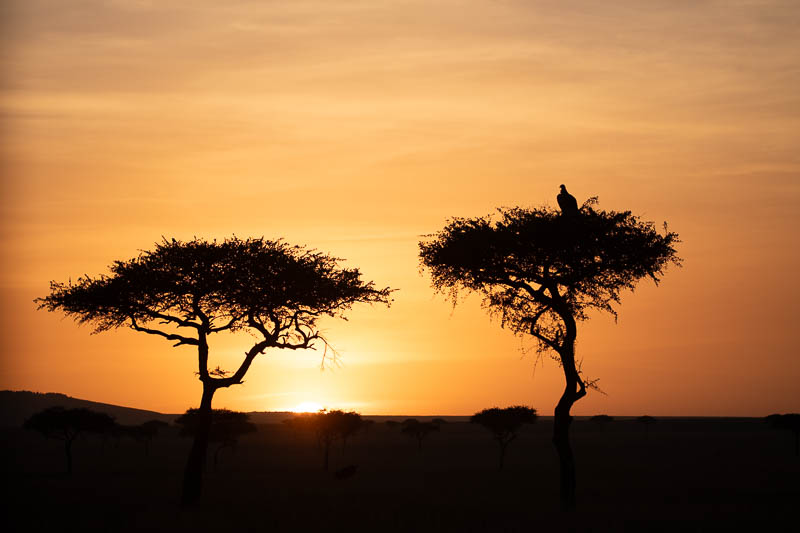
The Quiet Lamai Wedge
The Flightlink Grand Caravan out of Wilson lifts off before Nairobi has finished its first coffee, the city falling away below in the early haze. By the time we reach Arusha the day has shifted — the connection is tight and the visa process slow, so Phera’s coming through a few minutes behind me while I run ahead to check us both in. Twenty stressful minutes later, it all evaporates the moment we board the AuricAir flight north to Seronera, where a smaller Grand Caravan waits to take us the rest of the way.
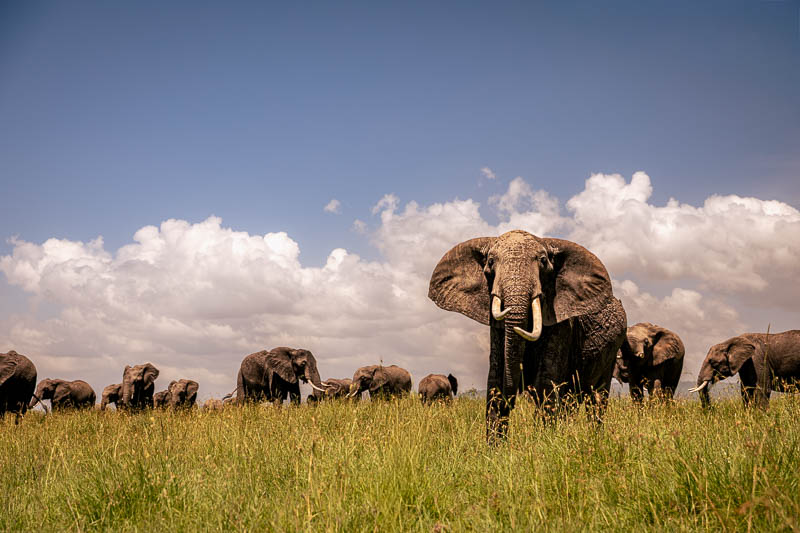
Collin and Maali meet us at the Lamai airstrip — our guide and spotter for the days ahead — and forty minutes later we’re pulling into Serian Serengeti Lamai, with the team waiting at the entrance. On the drive in, two bull elephants cross the track in front of us without breaking stride, the way large animals move when they’ve decided the track is theirs and the vehicle is a temporary inconvenience.
The camp’s position makes sense the moment you see it. Lamai sits with the Mara River close and the wedge opening north toward the Kenyan border, oriented for the river crossings that happen here at peak season — but right now those crossing points are quiet, the herds somewhere on the southern plains, and what the position gives us instead is access to a stretch of ecosystem that feels, for the next few days, entirely private. This is the “secret” season in Northern Serengeti.
Our first afternoon drive starts with the storm clouds building up. A Rufous-bellied Heron stops us first and then the rains arrive without warning and with complete conviction. For thirty minutes it comes down hard and we shelter watching a zebra herd that has turned as one body to face away from the rain, flanks to the wind, ears flat, collectively waiting it out with a patience that reads almost as dignity. When the shower passes, the air smells of wet grass and the plains are a shade brighter. On the way back to camp, a lone male lion is moving through the last of the afternoon light on the plains near the track — his evening roar reverberating into the night.
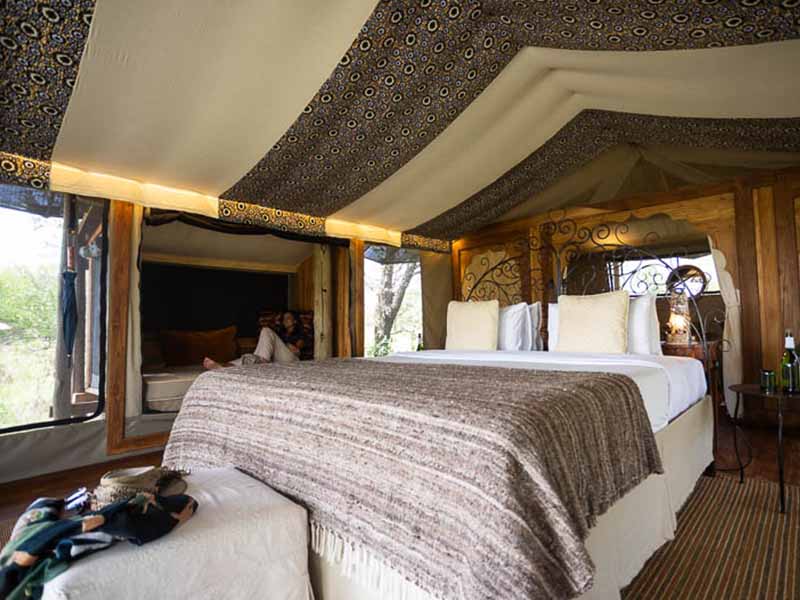
Back at camp, we discover the rain has done minor damage to the netting in our tent. The Serian team has moved us to a different tent entirely, transferring everything we’d unpacked to exactly the same positions in the new space. The night brings the plains to us: zebras snorting around the tent walls for what feels like hours, and at some point around 2am I wake to see silhouettes moving fast just outside — zebra and giraffe, the shapes of them briefly enormous against the canvas before they’re gone, hooves fading into the dark.
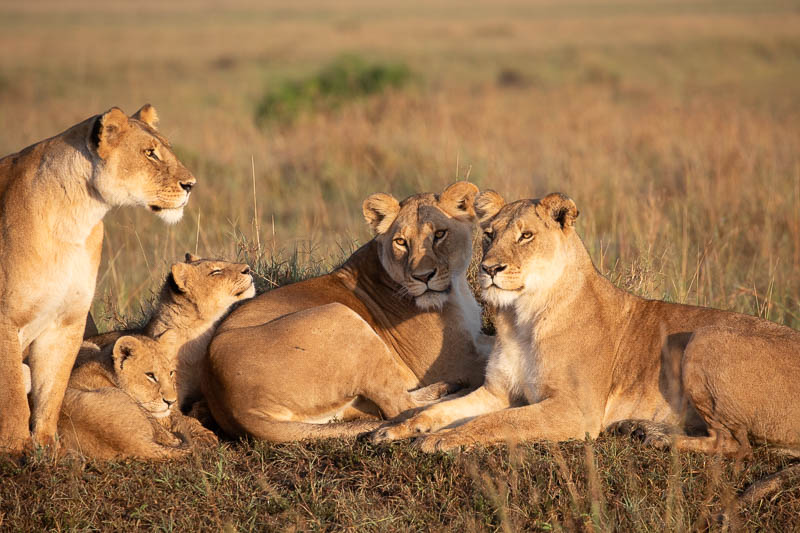
Tuesday begins with the skies completely clear and the kind of early light that justifies the alarm. Out on the Balanite Plains, Collin finds a large pride — ten lionesses and cubs resting on a low mound in the first warmth of the morning, their coats catching the angle of light in a way that makes the scene look almost too composed. Nearby, seven adolescent males and females occupy their own orbit within the same extended family. All of them are moving, the cubs shifting between adults with the characteristic combination of boldness and uncertainty, the whole pride spread out across the open ground with herds of zebra and topi hanging on the edges. It’s the kind of scene you drive into early in the morning and remember why you do this.
Further north, up where the Lamai Wedge approaches the Kenyan border, Collin finds the two big males from the pride’s outer circle — sleeping, but rousing periodically to offer elaborate yawns that seem slightly performative. A short distance away, three male cheetahs — brothers, almost certainly — have arranged themselves in the shade with the same commitment to horizontal rest. Lions and cheetahs sharing the same general address in the quiet season, everyone asleep, the Lamai Wedge very much doing its own thing.
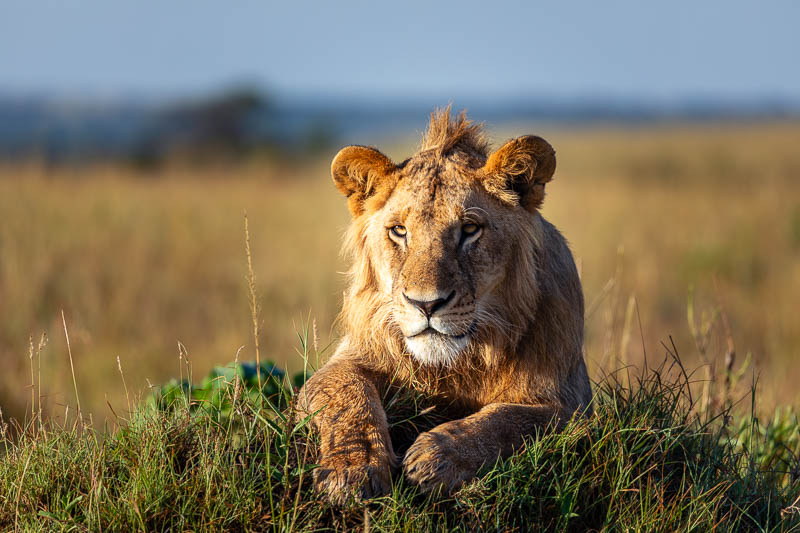
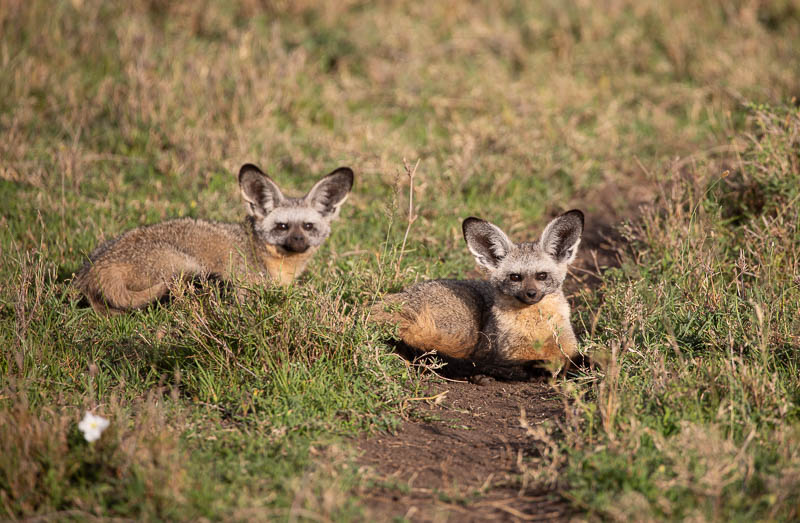
The heat builds through mid-morning and we come across a large elephant herd at a small waterhole — drinking, the younger ones dropping to their knees in the mud and rolling sideways, the adults’ movements around them patient and encompassing. Being this close to elephants behaving with complete ease does something to your pulse that you notice after they’ve moved on. In the evening we find the young male lion and his brother again, the clouds building briefly for a quick shower that sends the zebras into a short, chaotic sprint. Bat-eared foxes appear at dusk on the open ground, their ears disproportionately large and continuously swivelling. Collin finds a second pride further out — fourteen this time, females and cubs on a high vantage point looking down across the topi and zebra below, the cubs arranged along the edge like small spectators at a slow parade. On the way back into camp, a hyena den awakens for the evening.
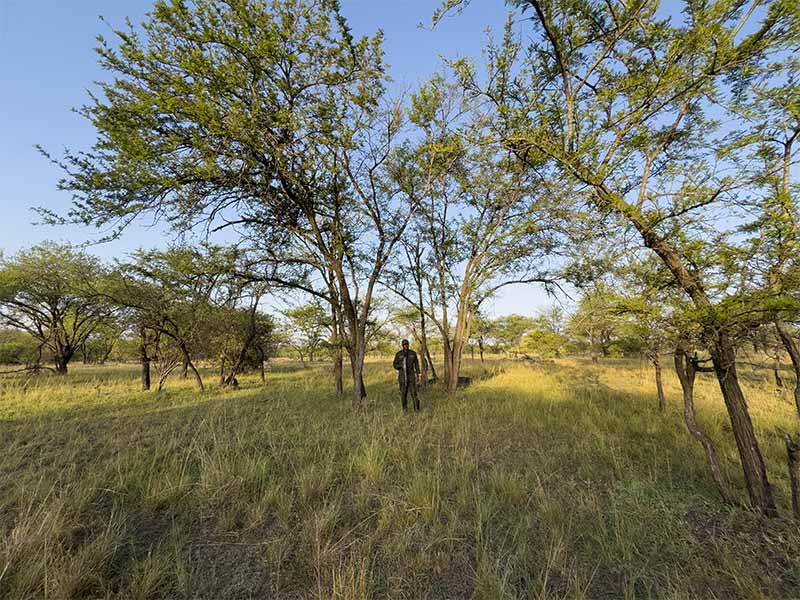
Wednesday begins at the Mara riverbank in the first grey light before the sun has cleared the horizon. The plan is a walking safari this morning — Maali and Collin have chosen a route that would take us along the river and out onto the plains — but it immediately requires adjustment. The hippos are out in force at this hour, too many of them between us and the planned direction to make the approach sensible on foot. They redirect us onto the plains instead, and we set off walking, falling into the particular rhythm of moving through the Serengeti without a vehicle: smaller steps, slower pace, the ground suddenly present in a way it never quite is from behind a windscreen. The texture of the grass underfoot. The temperature of the air at shin height. The way sound arrives without an engine to compete with it.
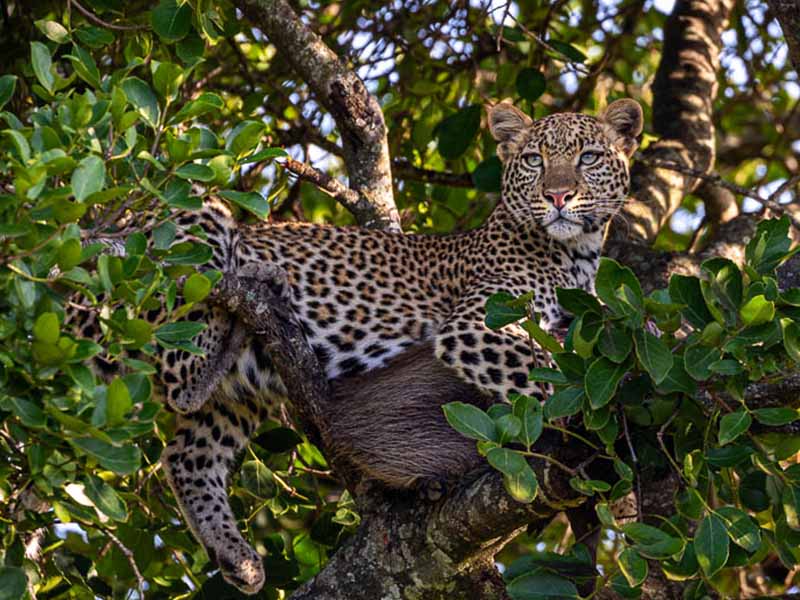
Maali has taken the vehicle ahead — the car moving out front while the walking party progresses with the ranger — when the radio crackles. Leopards. A mother and cub, with a warthog kill already in a tree. We can’t approach on foot; the cats would be gone before we got anywhere near them. He comes back to collect us and we drive in quietly to find the cub exactly as Maali described — gripping the kill in the branches with a concentration that makes it look like a child holding onto their favorite teddy bear. The mother is close and watchful. After time with them we drive back out five hundred metres and resume the walk on foot, picking up the thread of the morning.
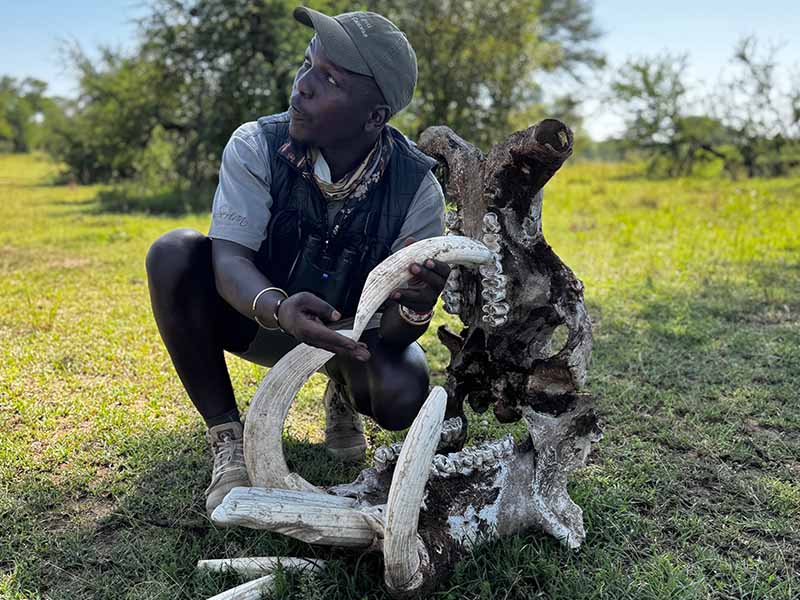
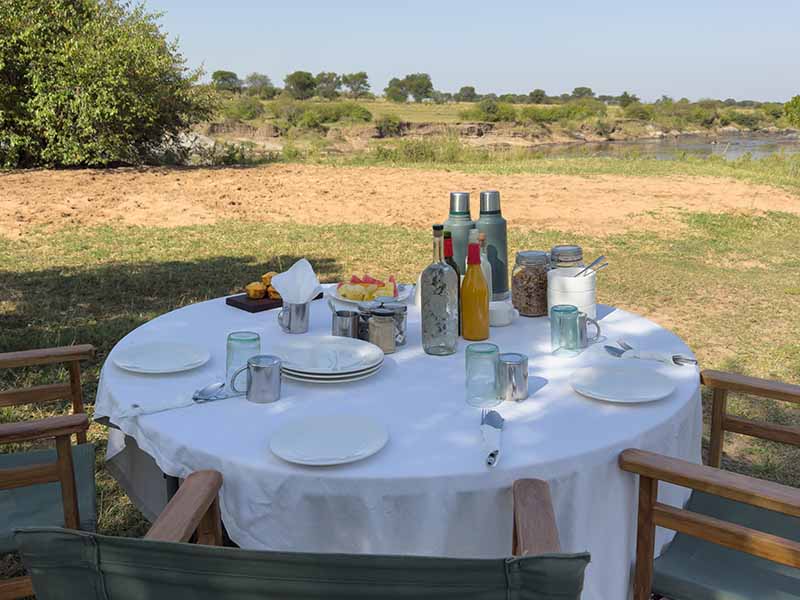
A lone buffalo — an old, solitary dagga boy — has registered our presence and decided that monitoring us personally is the appropriate response. We change direction; he moves along our flank, parallel, his gaze absolutely fixed, the set of his head communicating a suspicion he has no intention of dropping. One of the rangers keeps his own undivided attention on the buffalo. The situation resolves itself eventually and we reach the breakfast spot the camp has set up by the river: a grill going, the chef already at work, the whole arrangement on the bank with a formality that feels quietly absurd and completely right at the same time. Just around the bend in the river, visible from where we’re eating, a dead hippo floats with somewhere between twenty and thirty crocodiles in attendance.
In the evening we return toward the leopard. Along the way, two jackals have taken down an impala cub and begun feeding — but as we approach they run off, leaving the calf already partially eaten and still alive. We pull back quickly to let the jackals return and finish what they started. The whole encounter is over in a minute, but it leaves behind a particular understanding: the Serengeti isn’t staging anything for visitors. It’s just unfolding, constantly, in all directions, whether or not there’s a vehicle present to witness it.
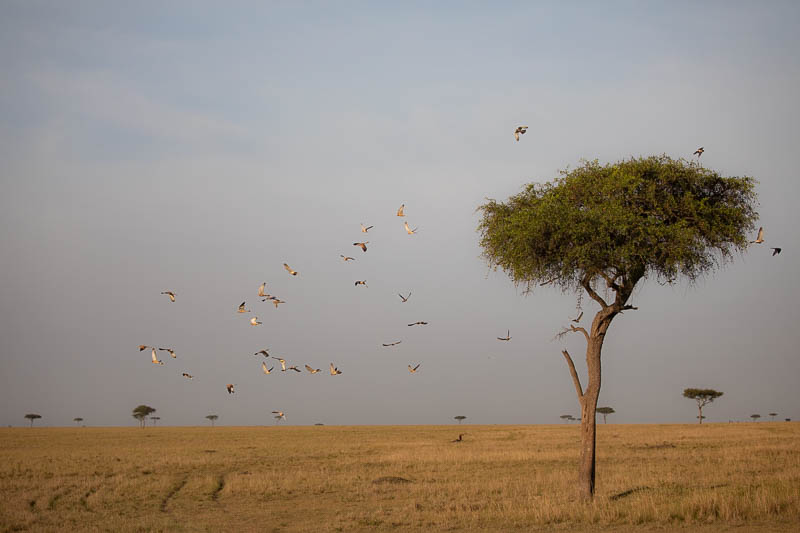
Thursday’s first light and one final drive before the hopper flight south. We go looking for the three male cheetahs and don’t find them — they’ve disappeared overnight. Collin finds a pride of seven lions instead: one young male, females, cubs, and one large male who is injured and moving carefully, being given quiet space by the others. On a single acacia, Maali spots something that takes a moment to parse: twenty, perhaps thirty lesser kestrels, flying continuously in and out of the branches, landing, launching, the tree itself seeming to vibrate with them. I have never seen that many together in one place, and I can’t imagine when I would again.
The hopper flight south is, by bush aviation standards, a proper journey: west first to Tarime to collect guests coming in from Kenya, then east across to Lobo to drop them, then a long diagonal south to Kusini — a good hour and a half in total, most of it over Serengeti that reveals itself, from altitude, to be even larger and stranger than any ground-level encounter can fully convey. The scale of it from above does something to the brain. By the time we touch down, the landscape has completely changed: no acacia woodland, no river, no wedge. Just short grass and open plain running to a flat horizon in every direction, and across all of it, as far as the light allows, wildebeest.
Calving Season in Kusini
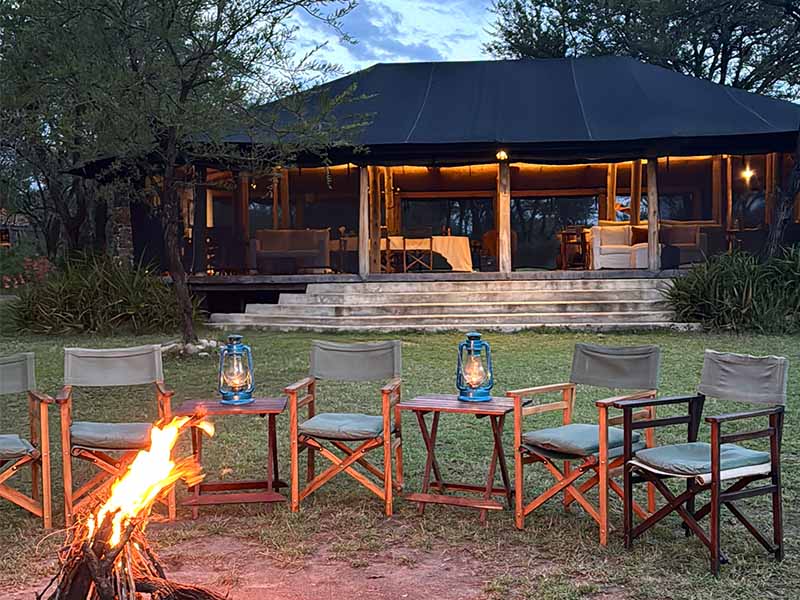
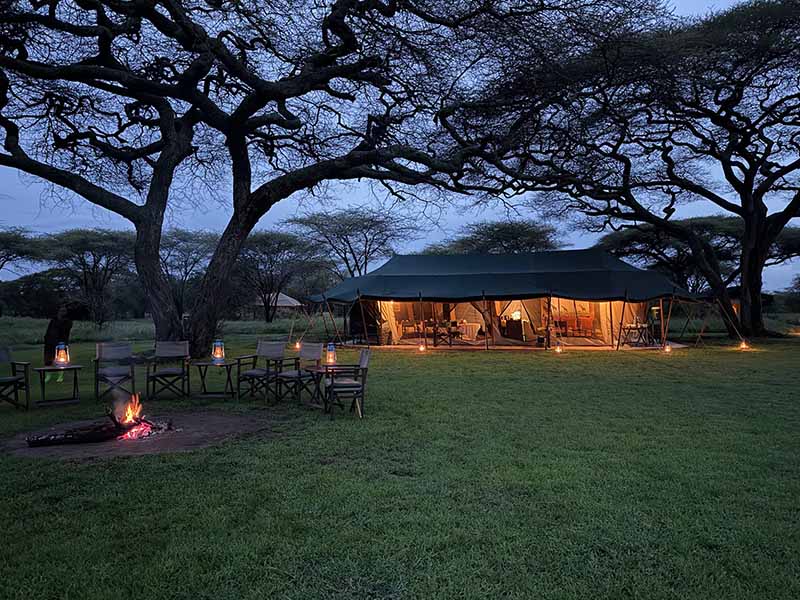
Serian Serengeti Kusini is not trying to be anything other than what it is. The camp is a mobile setup — it goes up for calving season, comes down afterwards, leaves no permanent mark on the land it temporarily occupies. When we arrive it’s sited in a pocket of shade beneath a pair of huge Tortillis acacia trees, their canopy broad enough to cover everything, their trunks the grey-white of weathered bone. Bucket showers, canvas walls, the fire going in the evening — guides Zaki and Tabo, host Zo. In a world where camps are increasingly competing on levels of luxury, there is something clarifying about a place that offers exactly what you need and makes no apology for the rest. Getting back to this feels like a reminder of what safari is actually about
That first evening Zaki takes us out toward some beautiful kopjes to the south and finds a pair of mating lions in the shade beneath them — the male’s brother occupying a diplomatic distance nearby, presumably having learned that proximity during these circumstances is best avoided. A young pride of five works the same general area.
Under the acacias back at camp a little later: wine by the fire, bucket shower warmth, the sound of the plains settling into the dark. It has been a full enough day.
Friday begins before light, the air cold enough that the breath shows, and nothing that follows is predictable.
Straight out of camp in the pre-dawn darkness and almost immediately — a zorilla. A quick, startled glance from the headlights before it vanishes into the grass. Then, as the sky begins to separate from the ground and the plain becomes visible in early grey, an African wild cat steps out and crosses ahead of us. A first for me. Smaller than you expect, the face domestic and simultaneously completely wild, gone before there’s time to do anything but register it. These are the sightings that don’t offer second chances: a flash of something, held in the mind for the rest of the morning.
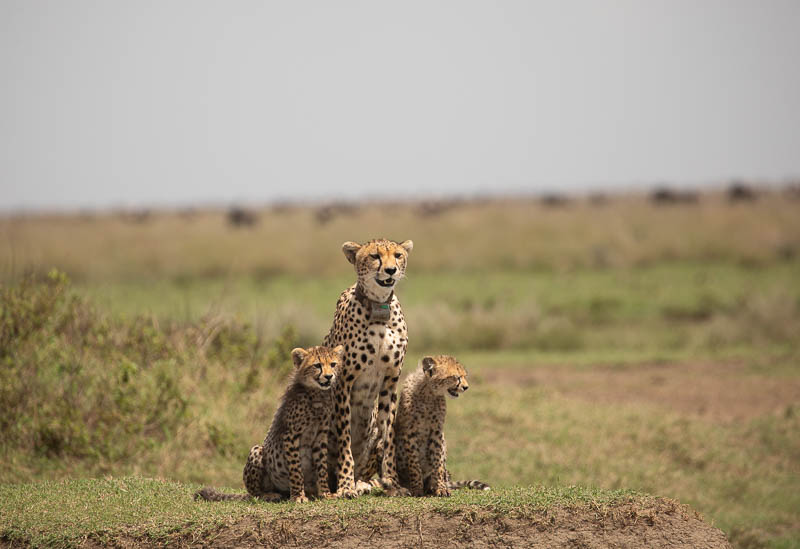
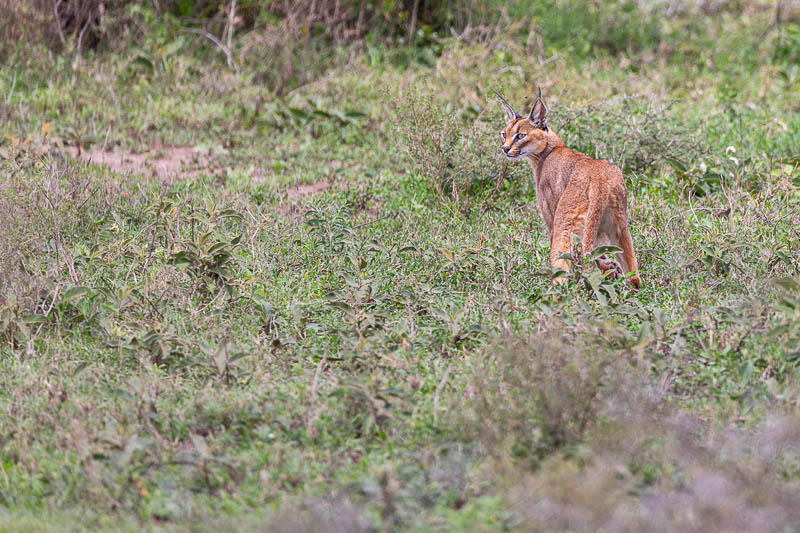
Then a cheetah and two cubs, moving along the plain in the growing light. And walking toward them — directly toward them, apparently unaware of their existence — a caracal. In broad daylight. On open ground. Caracals are largely nocturnal and famously shy. This one seems to be unaware of its reputation. It walks toward the cheetah family with the confidence of an animal that has made a significant navigational error but hasn’t noticed yet. What follows, as the cheetah cubs register the approaching caracal and give chase, and the caracal bolts in evident alarm, is — there is no more precise word for it — comedic. We follow briefly to confirm the caracal has recovered, then return to the cheetahs as they turn their attention to a wildebeest herd and make a half-hearted, unconvincing attempt at a hunt.
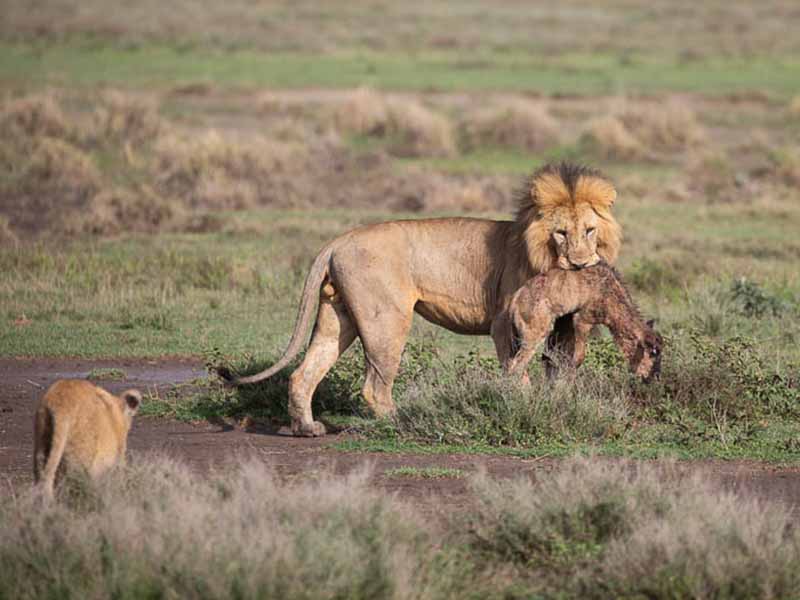
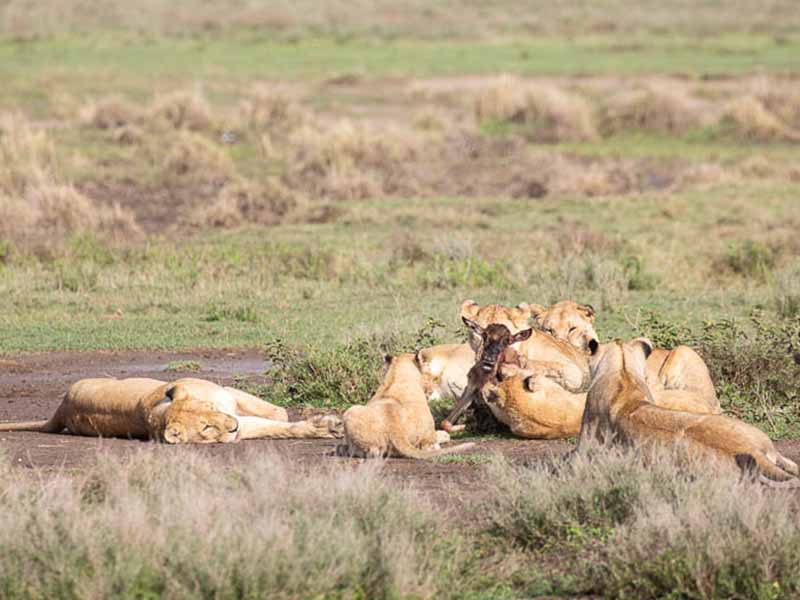
Then Zaki hears lions — five hundred metres off, maybe more. We drive toward the sound and find a pride of seventeen: a big male, females, adolescents, young cubs. They had made a wildebeest kill earlier in the morning, and the calf has come back — circling the periphery of the pride, unable to find its way clear of them. The big male had noticed. What followed was not easy to watch: he keeps the calf alive, uses it as a teaching mechanism for the cubs, moving it toward them and back, the whole sequence drawn out with a patience that reads almost as deliberate. The calf is alive throughout. Eventually it isn’t and the male lion feeds. This is calving season in Kusini: birth and predation happening simultaneously across the same short-grass plains, each one feeding the other, the whole system running without sentiment in every direction.
We go back towards the cheetahs and instead find a different male cheetah — shyer, keeping more distance. As we settle down for a bush breakfast among the herds, we spot a Marsh owl, calm unbothered and completely unfazed by our presence.
A second caracal appears on the way back to camp for lunch, apparently committed to making this as implausible as possible.
The afternoon takes us back out in a different direction. A female cheetah with four young cubs has fed and is resting, the cubs draped across each other and across a low shrub in the open with the total physical abandon of animals that have eaten well.
The big lion pride is beginning to split for the night when we catch up to them, the last of the daylight going out of the sky — adolescents splintering off from the main group, the adults beginning to spread. We park in the gap between the two groups as the separation happens, and the roaring starts. Not in the distance. All around us, from both directions, at a volume that occupies the chest as much as the ears. Two groups of lions communicating across the space we happen to be sitting in, the sound bouncing between them in the cooling air. It is an ending the day has earned.
Saturday has a specific mission. Zaki frames it plainly: we are looking for a wildebeest birth. This sounds straightforward until you are actually doing it — moving through a sea of wildebeest that extends for miles, trying to identify the single female who is in labour right now, at this exact moment, as you drive past her. The calving season is winding toward its end and the births are less frequent. There is a lot of slow driving and looking.
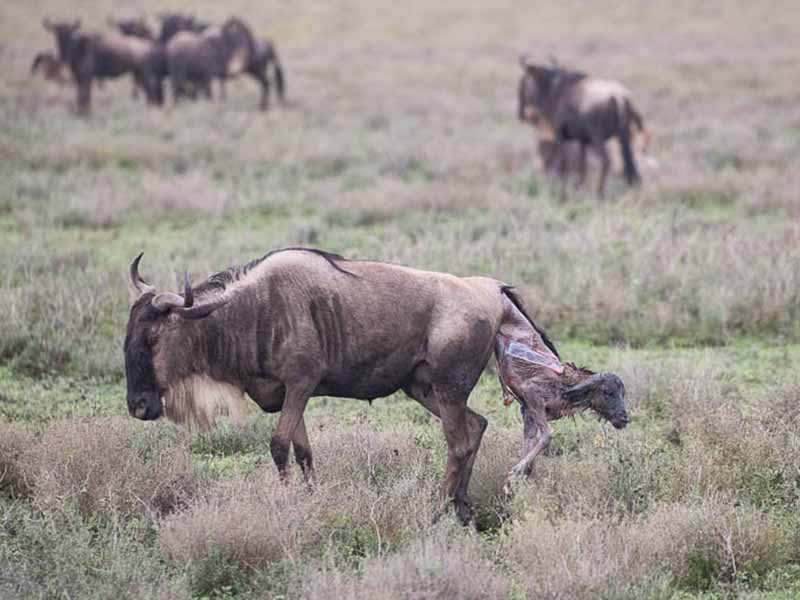
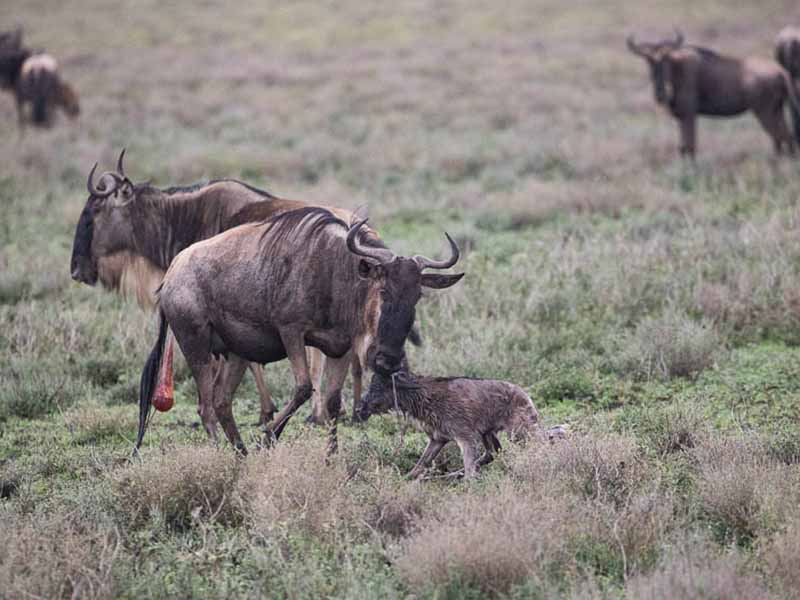
By 8am we find her. A female, halfway through. We stop, engine off, and wait. The calf arrives — folding out, then attempting to stand with an urgency that is striking given that it is minutes old. Within a very short time it is upright and moving. They have to be: the herd will not pause, and a stationary newborn is a visible advertisement to everything that hunts. The whole sequence, from finding the female to the calf walking alongside her, takes less time than it has any right to. Less time than seems fair, given what it is.
After the rains, small waterholes have pooled across the plains, the permanent ones growing. At one of them, wildebeest are wading through the shallows while Abdim’s storks, yellow-billed teal, white-faced whistling ducks and terns move around and above them in overlapping layers. Quite the picturesque scene.
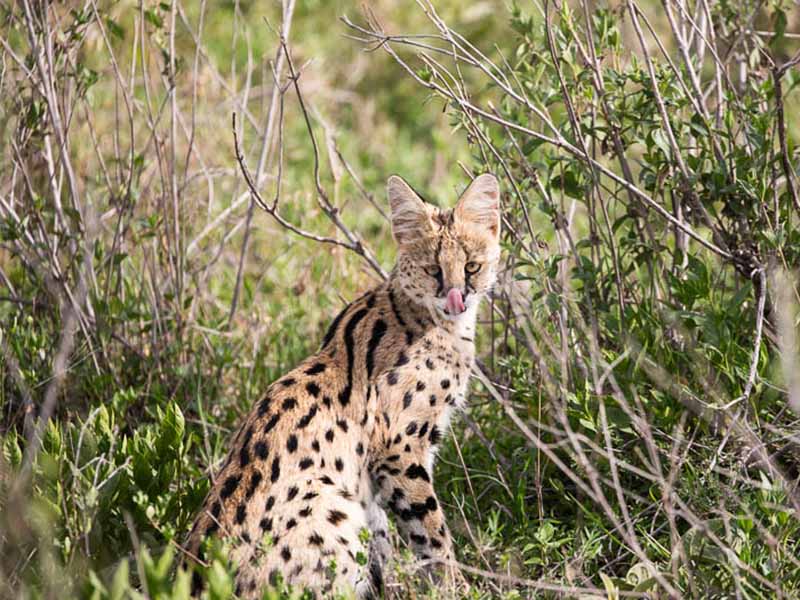
As the evening drive closes toward the tree line, Zaki catches a movement on the far side of the forest: a serval, hunting the low grass. We watch it work systematically — searching for rodents, making two or three pounces, coming up empty each time — before it moves on and we follow. Bat-eared foxes: a pair, relaxed, ears swivelling constantly in the cooling air. And then, at the very end of the drive, a shape in an acacia tree that resolves, slowly, into a young male leopard, up high, sleeping with the total ease of an animal entirely confident in its position. We have now seen every cat species that the Serengeti has to offer, across two days in Kusini. Lion, cheetah, leopard, serval, caracal, African wild cat. Three caracals in a single day. Even Zaki, who has spent more time on these plains than I can reasonably estimate, takes a moment with that one.
Sunday morning, final drive.
A wildebeest calf has separated from its mother overnight and is running through the herd in visible distress — looping, searching, attaching itself briefly to animals that are not what it’s looking for. It attaches itself to our vehicle instead, following us through the grass with a misplaced faith in our navigational skills. We steer it gently toward a large group before slipping away, hoping something in there resembles what it needs.
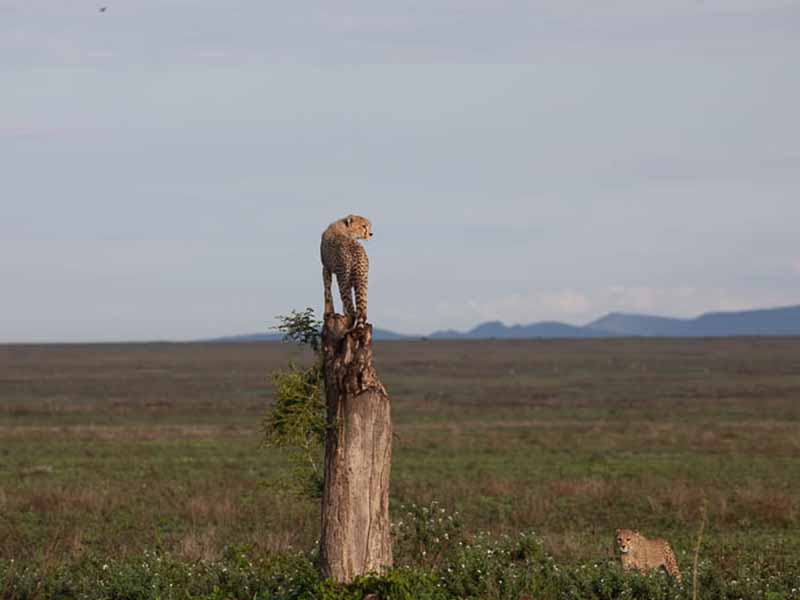
The cheetah and two cubs are in beautiful morning light near a dead tree, the cubs using it as a climbing frame with mixed results. In the middle distance, a herd is moving and there is another lost calf circling its edges — the same choreography, repeated. The cheetah registers it, tracks it for a while, eyes narrowing. Then, for whatever reason — hyenas working nearby, something in the wind — she turns away and continues on. The cubs tumble down from the dead tree and follow her.
We head back to camp for breakfast, then to the airstrip.
As the plane begins its takeoff roll, a journey of giraffe settles at the far end of the runway — five or six of them, arranged across the tarmac with a serenity that suggests they have not registered the distinction between airstrip and everything else. The plane aborts, swings back, and the guide car accelerates past to encourage the giraffe to reconsider their position. They do, eventually. We take off.
Flying north toward Arusha, we stop at Chem Chem for a pickup. Another journey of giraffe on the runway. Most have cleared, but one youngster is still ambling diagonally across the strip as we come in, and the pilot aborts the approach, banks, loops, and tries again. The giraffe completes its crossing at its own pace and disappears into the bush without any apparent awareness of having caused an inconvenience.
We’ve been outmanoeuvred on both takeoff and landing by animals that don’t know what a runway is. It seems about right for a trip that has, from the first afternoon, been operating entirely on the Serengeti’s terms.
Ready to experience the Serengeti in February — when the quiet season in the north meets the chaos of calving in the south? We’ll design a journey that positions you exactly where you need to be, when it matters most.